
Susquehanna County Projected Release Dates
A projected release date is a current calculation of when custody may end if the known sentence and credits remain unchanged. An actual release date records an event that already occurred. A minimum date often marks the first point at which parole may be considered. A maximum date is the outer sentence limit after lawful calculations. These terms answer different questions and should never be swapped.
Susquehanna County adds another layer. Its former correctional facility closed, so county detainees may be held by Wyoming, Wayne, or Lackawanna County. The Susquehanna docket still supplies the court order, but the receiving jail holds the operational custody record. For a state commitment, PA DOC becomes the calculator. A departure from one receiving jail can also be a transfer, not release to the community.
- Minimum date
- The usual first parole-eligibility point under an indeterminate sentence.
- Maximum date
- The sentence boundary after the agency applies lawful credit and calculation rules.
- Custody credit
- Credit for qualifying time already spent in custody.
- Detainer
- A request or legal hold that may transfer the person to another authority.
- Rescission
- Withdrawal of a parole grant before release under the governing process.
Find Susquehanna County Release Dates
Begin with custody class, not a name search alone. A person awaiting trial often has no fixed sentence release date. Bail or a court order may permit release, yet another hold can prevent an immediate exit. A sentenced county detainee may have a minimum, maximum, time-served term, or other court direction. A state prisoner has a PA DOC sentence calculation and may face a Parole Board decision.
- Search the UJS Case Search for the Susquehanna County case. Confirm the person through docket identifiers, then use the Clerk’s records process if a certified local order is needed.
- Identify the actual custodian. For a recent county case, ask Inmate Control and Coordination whether Wyoming, Wayne, or Lackawanna holds the person.
- Ask the receiving jail for current status and how it applies the order. A court sentence does not reveal the exact door-out time.
- If the sentence is state confinement, use the PA DOC locator to confirm jurisdiction, then request the current sentence-status calculation from DOC.
- Check for a Parole Board action, detainer, revocation, or later court order. Each can affect the expected date or destination.
- After the event, confirm the actual exit date and disposition with the custodian. The Susquehanna County release-record search gives the full post-release verification chain.
A narrow question gets a clearer answer. Ask for the judicial minimum and maximum, credit already applied, current calculated sentence status, known holds, and whether a date is eligibility, planned transfer, or actual discharge. Do not ask an office to promise a future physical release that depends on later events.
The custody chain can span more than one county. A Susquehanna order may govern the case while a neighboring institution applies its day-to-day release process. If the receiving jail reports that the person departed, ask for the destination and the release type. Return to Inmate Control when the answer points to another placement. A transfer date ends one custodian’s control but does not become the projected end of all custody.
PA Locator Release Date Limits
The public PA DOC Inmate/Parolee Locator guidance says the tool covers people currently under DOC jurisdiction and updates daily. It excludes county correctional populations. That means a Susquehanna detainee boarded in a neighboring county jail will not appear merely because the case is in Pennsylvania. The inmate side requires at least a last name or inmate number and offers filters such as first name, sex, committing county, current location, date of birth, and age.
More important, the current inmate detail does not expose a field labeled Projected Release Date, Tentative Release Date, Minimum Date, Maximum Date, or an equivalent future sentence field. The Department Supervised Individual side has an exact field labeled Release Date. That value refers to an actual release into community supervision. It cannot be relabeled as a projection.
The official PA DOC locator interface shown below is useful for confirming DOC jurisdiction and later supervision, not for reading a public future date that the interface does not provide.
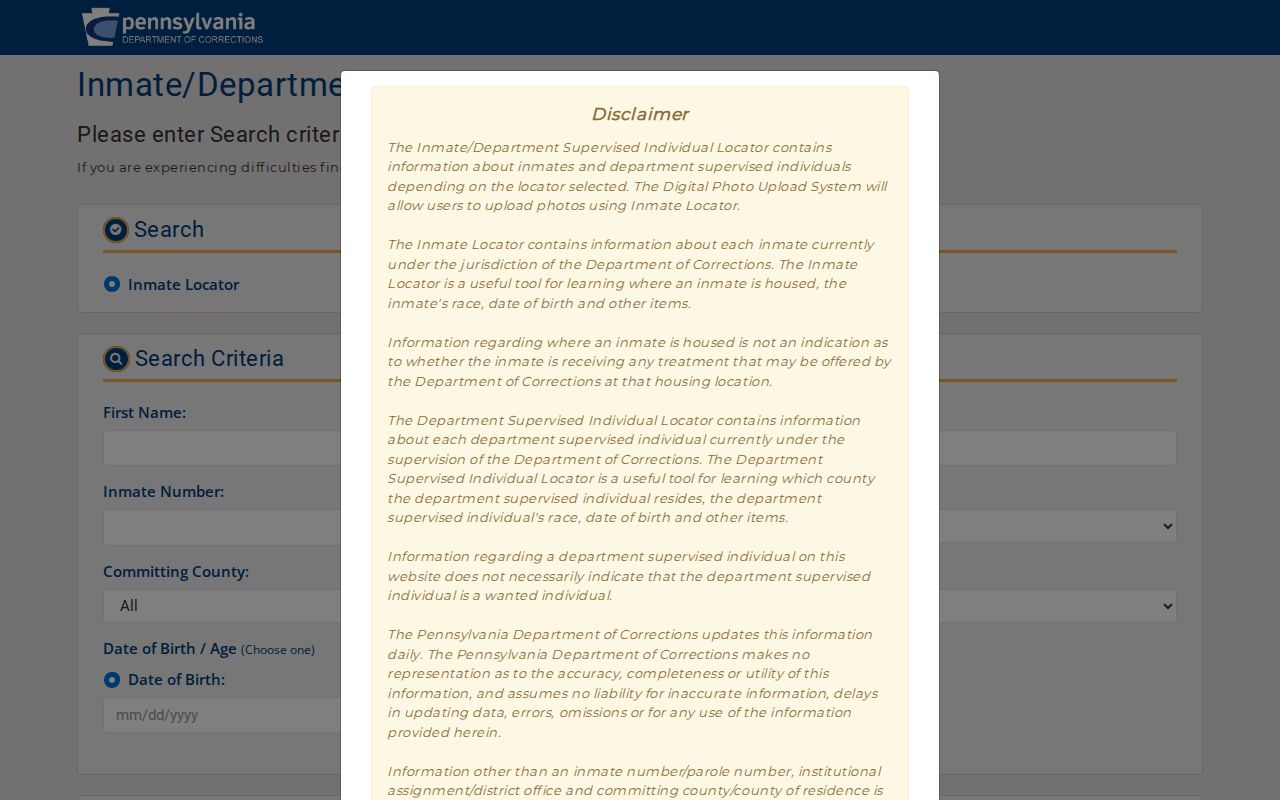
The screenshot must be read with that limit. A supervised-person result can confirm an actual Release Date after the event, while a current future calculation must come from sentence records and the responsible agency.
Note: The PA DOC public locator has an actual Release Date field for supervised people, not a public projected-date field for inmates.
Susquehanna County Sentence Calculations
Pennsylvania uses indeterminate sentencing for many confinement terms. Under 42 Pa.C.S. §9756, the sentencing court generally sets a minimum and maximum, and the minimum ordinarily may not exceed one-half of the maximum. The minimum is usually the first parole-eligibility point. It is not a command that PA DOC must release the person that day.
42 Pa.C.S. §9760 governs credit for qualifying time in custody. Credit can affect how the imposed term is calculated, but the docket may not reflect every later agency calculation. Concurrent terms may run together, while consecutive terms may be aggregated. A court modification, corrected credit decision, or revocation can alter the expected endpoint.
Pennsylvania does not have a blanket federal-style rule requiring each prisoner to serve about 85 percent. Ordinary state parole authority and exclusions appear in 61 Pa.C.S. §6137. Life, death, mandatory provisions, and other exclusions require case-specific treatment. Eligibility at the minimum remains distinct from a favorable parole vote and executed release.
The Parole Board’s official process materials explain that decisions depend on statutory review and the applicable voting path. Some matters use a panel, while specified cases require a Board majority. Outcomes can include a grant, refusal, deferred review, or later rescission where authorized. A public Board meeting schedule is not a calendar of named parole interviews. The person’s Board Action is the record to seek when a projected date depends on discretionary state parole.
Susquehanna County Special Release Paths
The Recidivism Risk Reduction Incentive, called RRRI, is a specialized Pennsylvania mechanism rather than general “good time.” 61 Pa.C.S. §4503 defines eligibility and exclusions. For an eligible person, §4505 generally sets the RRRI minimum at three-fourths of a minimum term of three years or less, and five-sixths when the minimum exceeds three years. Section 4506 governs program and parole mechanics.
Short Sentence Parole is separately addressed in 61 Pa.C.S. §6137.1. These programs do not let a reader calculate a firm date from sentence length alone. Eligibility, exclusions, program completion, Board action, holds, and current agency records all matter. The named person’s sentence-status record remains the sound source.
No official Susquehanna source reviewed established a county good-time formula, weekend-advance rule, fixed gate schedule, or routine release hour. Those facts should not be borrowed from another county. For a county term, use the actual receiving jail’s process and the Susquehanna order.
County parole is also separate from state parole. Susquehanna County Adult Probation handles county parole, while PA DOC supervises state parole after a Board release. The same words may appear in a docket, but the office with the live calculation differs. Confirm whether the sentence remains a county term or became a state commitment before relying on any date supplied by one agency.
Changes to Susquehanna Release Dates
A future date can shift for legal or operational reasons. Some changes affect the sentence math. Others leave the sentence intact but change whether the person can walk into the community on a given day. The record should identify which type occurred.
| Factor | Possible effect | Best source |
|---|---|---|
| Custody credit | Changes the amount of qualifying time applied | Sentencing order, docket, agency calculation |
| Concurrent or consecutive terms | Changes how multiple terms combine | Court order and sentence-status sheet |
| Parole grant, denial, or deferral | Changes whether release can occur near eligibility | Parole Board Action |
| Rescission or misconduct | May prevent an expected parole release | Board and PA DOC records |
| Detainer or warrant | May send the person to another authority | Custodian disposition and issuing authority |
| Court modification or revocation | Can alter the governing sentence | Later docket and certified order |
| RRRI or special program status | May create a distinct eligibility path | PA DOC and governing statute |
A bail payment is also not a projected sentence calculation. It may authorize a pretrial release, but processing and another hold can prevent immediate exit. Susquehanna’s after-hours bail paths differ by court level, and no sourced local rule promises release at a set time.
Movement records can clarify an apparent change. The Susquehanna Sheriff transports prisoners to and from correctional facilities in and outside Pennsylvania. A transport entry may reflect a court trip, new placement, or handoff to another authority. It does not prove discharge. When a date shifts near a transport, identify the destination and confirm arrival before concluding that the sentence calculation changed.
Request Susquehanna Release Calculations
When the public sources stop short, request an existing record from the agency that performs the calculation. For a state sentence, the PA DOC Right-to-Know service routes requests to the Office of Chief Counsel, 1920 Technology Parkway, Mechanicsburg, PA 17050. The posted phone is 717-728-7763 and the email is RA-docrighttoknow@pa.gov.
Describe the person by full name, aliases, inmate number, date of birth if known, committing county, and a useful date range. Ask for the current sentence-status or commitment calculation and the release or discharge date and mechanism if the event has occurred. An agency may redact protected information, deny an exempt record, or state that it does not possess the item. Online visibility and agency retention are also different questions.
For a county sentence, direct the operational timing question to Wyoming, Wayne, or Lackawanna when that jail is the actual custodian. Use Susquehanna Inmate Control to identify placement and the Clerk or UJS for the legal order. For state parole timing, the Susquehanna County probation and parole record path distinguishes the Board decision from PA DOC supervision.
A records response may identify the calculated minimum and maximum without giving a guaranteed gate date. Read each field under the label used by the agency. If the calculation has an “as of” date, preserve it. Then compare it with the newest court order and Board Action. A later record should not be silently combined with an older calculation as though both described the same point in time.
Note: A five-business-day Right-to-Know response period is not a promise that the requested calculation will be produced within five days.